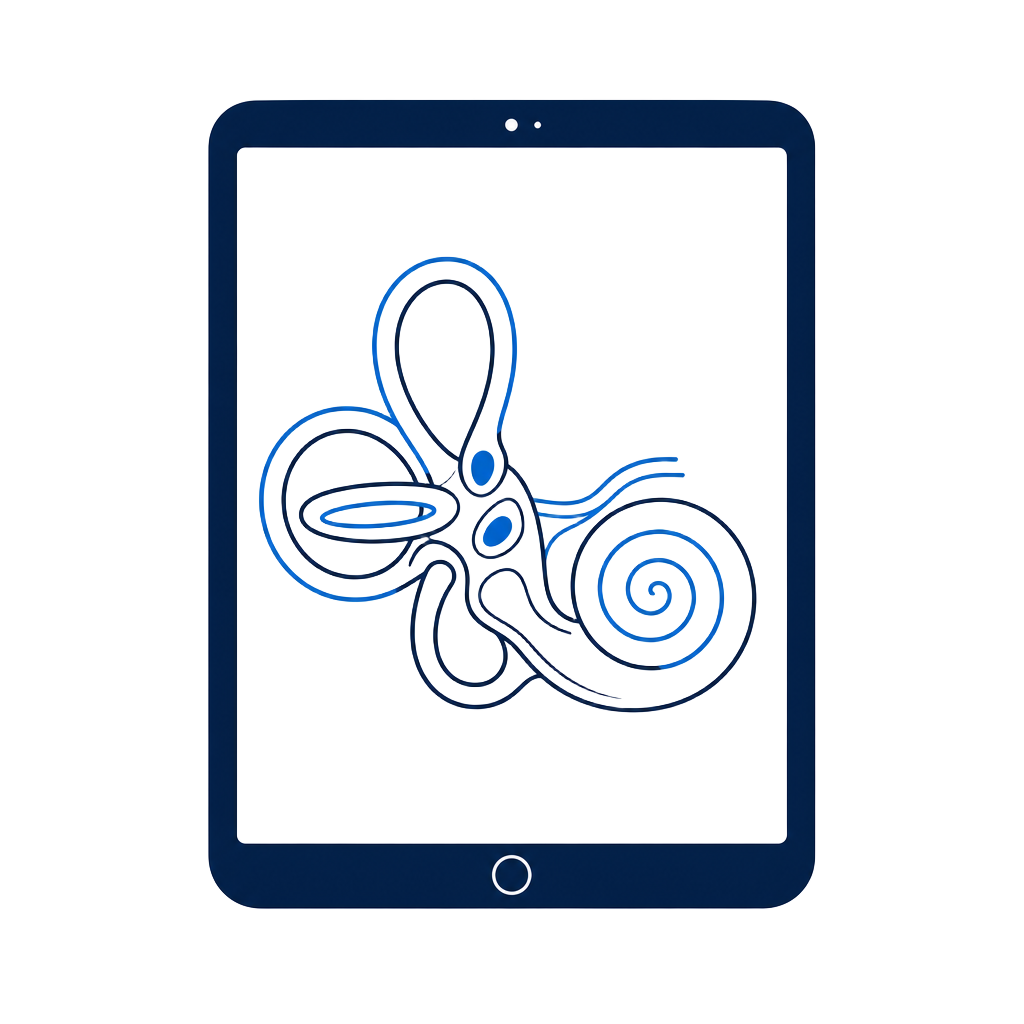
BPPV (Benign Paroxysmal Positional Vertigo)
Brief spinning triggered by head movement — often the easiest vestibular condition to fix.
Benign Paroxysmal Positional Vertigo (BPPV) is the single most common cause of vertigo in adults. It accounts for roughly 20 to 30 percent of all dizziness complaints seen in specialty clinics, and the lifetime prevalence in the general population approaches 10 percent. In simple terms: at some point, one in ten people will feel the world spin when they roll over in bed, and BPPV is very often the reason.
The name itself is a description. Benign means it is not dangerous. Paroxysmal means it comes in short, sudden bursts. Positional means head movement triggers it. Vertigo is the sensation of spinning. So: brief, position-triggered spinning that is not life-threatening. That combination is BPPV until proven otherwise.
Here is why it matters that BPPV is so specific: it is arguably the most fixable condition in all of neurology. A trained clinician can identify which ear and which canal is involved in under five minutes of positional testing, and treat it with a guided repositioning maneuver, most commonly the Epley, in another five. Peer-reviewed data show single-treatment resolution in roughly 80 percent of cases, and 90 percent-plus after a second visit. Very few conditions in medicine offer that kind of clarity.
The problem is that most people with BPPV are not diagnosed correctly. They get referred for MRIs (usually normal), for cardiology work-ups (also normal), for anti-anxiety medication (which does nothing for a mechanical inner-ear problem), and often for months of general balance exercises that miss the point entirely. If you have BPPV, you do not need generic balance training. You need someone to look at your eyes during a Dix-Hallpike test and put the crystals back where they belong.
Symptoms of BPPV
The single most classic BPPV symptom. Rolling toward the affected ear brings on a burst of vertigo that peaks in under a minute and then settles. Many patients describe waking up, turning to look at the clock, and the room spinning.
Reaching up to a high shelf, tipping the head back at the hairdresser, bending down to tie a shoe. These provocative head positions move the loose otoconia (calcium crystals) through the semicircular canal and set off vertigo.
True BPPV episodes are short. Seconds to under a minute is typical. If you are dizzy for hours at a time without moving, that is not BPPV alone: it is either another condition or BPPV plus something else.
The vestibular system is directly wired to the brainstem area that controls nausea. Sudden vertigo produces sudden nausea. Sitting still usually helps.
BPPV is a problem of the semicircular canals, not the cochlea. If you have significant hearing changes or new tinnitus with vertigo, another diagnosis (Meniere's, vestibular neuritis, superior canal dehiscence) has to be ruled in or out.
Some patients feel off or unsteady even when they are not actively spinning. This is normal, resolves after the BPPV is treated, and often responds well to a brief course of balance retraining.
Diagnosis
BPPV is a clinical diagnosis. That means no imaging test can confirm it and no blood work is needed. What identifies BPPV is a set of position tests, most importantly the Dix-Hallpike test for the posterior canal and the supine roll test for the horizontal canal, during which a trained clinician observes your eyes for a characteristic nystagmus (involuntary eye movement) that matches the canal involved.
Virtual assessment sounds like it should be harder than in-person, and for many conditions it is. BPPV is a striking exception. Because the diagnostic step is watch what the eyes do when the head moves into a specific position, a good camera and a coached patient (or family member) let a vestibular specialist see exactly what they would see in the clinic. Multiple published studies now confirm remote positional testing correlates well with in-person Dix-Hallpike when the exam is coached carefully.
The differential matters. A subset of patients who look like they have BPPV actually have vestibular migraine, orthostatic hypotension, cervicogenic dizziness, or, very rarely, a central cause. Part of the initial evaluation is ruling these in or out, which is why we take the time to work through a complete exam rather than a rushed 10-minute screen.
Treatment
The Epley is the treatment of choice for posterior canal BPPV, which is roughly 85 to 90 percent of cases. It is a sequence of four head and body positions, each held for 30 to 60 seconds, that walks the loose otoconia out of the affected canal and back into the utricle where they belong. It is coached live over video, and the patient (with or without a family member) performs the sequence in real time.
An alternative to the Epley, useful for patients with mobility limits that make full head rotation difficult. Outcomes are comparable.
For horizontal canal BPPV, which behaves differently from posterior canal BPPV and requires a different repositioning strategy. Getting the canal right is the entire game: treating a horizontal-canal BPPV with an Epley will not work, and vice versa.
Most patients are given a set of self-Epley or Brandt-Daroff exercises for the first one to two weeks after resolution, plus a very brief balance progression if residual unsteadiness persists.
Meclizine and other vestibular suppressants do not treat BPPV. They can mask the nystagmus that makes the diagnosis possible, and long-term use actually delays central compensation. The 2017 AAO-HNS clinical practice guideline explicitly recommends against routine vestibular suppressants for BPPV.
Recovery and outlook
The single most important expectation to set is that BPPV recovery is not gradual: it is stepwise. A correctly performed Epley eliminates most or all of the vertigo in one session, in roughly 4 out of 5 patients. If a second visit is needed, it is usually because the crystals moved into an adjacent canal (canal conversion), not because the treatment failed.
Residual imbalance for a few days after treatment is normal and does not mean the BPPV is back. The brain has been receiving a stream of abnormal position signals, and it takes a short adjustment period to recalibrate. A brief home balance program accelerates this.
Recurrence rates for BPPV are non-trivial. Roughly 15 to 20 percent of patients will have a recurrence within one year, and up to 50 percent within five years. This is not a failure of treatment: it is the natural history of the condition. What matters is knowing what it is, so that a recurrence can be treated in one virtual visit instead of another six months of specialists.
Frequently asked
BPPV is the only kind of vertigo that is purely position-triggered and lasts under a minute per episode. Vertigo that lasts hours, that comes with hearing changes, or that happens sitting perfectly still is almost certainly something else.
Yes. The Dix-Hallpike, Epley, and Semont are all coached over secure video. The key is a good camera angle, a bed or couch with room to lie back, and, for older adults, a family member nearby to help with positioning.
One session resolves BPPV in roughly 80 percent of patients. A second session brings that number over 90 percent. If a third session is needed, the diagnosis is re-examined.
Yes, in 15 to 20 percent of patients within a year. Recurrence is treated the same way as the first episode: one virtual visit, one guided maneuver.
Almost never. BPPV is a clinical diagnosis. Imaging is only warranted if the exam findings suggest a central cause, which is a small minority.
No. BPPV itself is not dangerous. What is dangerous is the fall risk during an episode, which is why most patients benefit from a brief post-treatment safety plan.
For BPPV specifically, no. It suppresses the nystagmus needed to diagnose the condition and offers no mechanical benefit. It is not recommended by the current AAO-HNS practice guideline.
Research and references
The definitive US clinical practice guideline. Recommends against imaging and against vestibular suppressants for uncomplicated BPPV; supports canalith repositioning as first-line.
Meta-analysis confirming the Epley maneuver's efficacy over sham for posterior canal BPPV.
APTA Neurology Section CPG; covers post-BPPV residual dizziness and vestibular hypofunction.
Research references are provided for education. This page is not medical advice; it is an evidence-based summary of published vestibular literature.
Related conditions
Related articles
Also treating
You don't have to live this way.
Book a free 15-minute consultation with a Doctor of Physical Therapy. No commitment — just clarity.